

You are now on the AHDB Horticulture and Potatoes website.
Please click here to access the main AHDB website and other sectors.
Please click here to access the main AHDB website and other sectors.
Horticultural businesses often need to transport workers to fields separate from their accommodation or normal place of work, between different fields, or to and from shops to buy essential items. Workers can be grouped into cohorts (LINK HERE) that always travel and work together, to minimise any potential spread of COVID-19. However, whilst travelling between locations social distancing measures must still apply.
Where employees are travelling to and from the workplace in private vehicles or using carpooling, employers are encouraged to remind them of current government advice (see section: 'Use of private vehicles and car-pooling') on best practice.
Where employers are providing transport for employees between accommodation and the workplace, between different work settings, and for essential shopping purposes, please see the below best-practise suggestions:
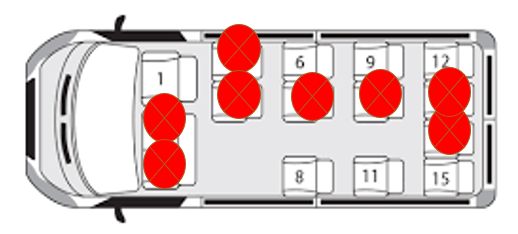
Example of a bus with reduced numbers of passengers – the seats coloured red should be left empty.
Employers should consider supporting workers with shopping by selling basic supplies on site (using contactless payment if possible) or facilitating food deliveries, to reduce their requirement to travel. If workers need to travel off site to buy food and essentials, the Government guidance must be followed. It is best practice for employer-organised shopping trips to be managed in cohorts.
These are exceptional circumstances and industry needs to comply with the latest government advice on coronavirus (COVID-19). This best-practice document is based on Public Health England (PHE) guidance; other restrictions and advice may apply in Scotland, Wales and Northern Ireland.
This guidance does not change or amend the statutory duties of an employer under the health and safety legislation, including, in particular:
This best-practice guide is intended to assist employers of agricultural seasonal workers in applying the PHE guidance in practical ways. The information and examples provided in this guide are illustrative only and may not be suitable for every business.
This guide was produced in collaboration with the National Farmers Union, The Association of Labour Providers, AHDB, G’s Fresh and Defra.